Travesti (gender identity)
Travesti (gender identity)
Travesti is a gender and political identity of strictly Latin American origin—consolidated with particular historical density in Brazil and Argentina—referring to people who were assigned male at birth, but who construct their existence, subjectivity, and bodily expression within the feminine spectrum and in dissidence with cisnormativity.
The category is marked by its cultural specificity and untranslatability: the term has no direct conceptual or semantic correlates in other languages (such as English, French, German, Russian, Mandarin, Japanese, or Arabic). In these languages, the word is often inadequately translated by terms such as cross-dresser, transvestite, or compulsorily assimilated into the Anglo-Saxon medical category of "transsexual woman". In Latin America, however, travestility constitutes an autonomous, territorialized identity that is inseparable from markers of class, corporality, and anti-colonial resistance.

Projection mapping on the National Congress in Brasília in allusion to the National Trans and Travesti Pride Day.
(Photo: Agência Senado / Flickr, May 15, 2024. License: CC BY-SA 4.0)
---
1. Etymology, Untranslatability, and Semantic Transmutation
The word traces back to Vulgar Latin transvestire ("to change clothes", "to wear another's attire"), which derived into the Italian travestire and the French travesti. During the 18th and 19th centuries, the term operated under two axes:
1. The aesthetic/theatrical axis: The artistic convention in which actors performed roles assigned to the opposite sex (rôle travesti or stage performances en travesti);
2. The medical-pathologizing axis: In the late 19th century, with the emergence of European sexology through the works of Richard von Krafft-Ebing (Psychopathia Sexualis, 1886) and Magnus Hirschfeld (Die Transvestiten, 1910), the term was fixed in psychiatric manuals under the label of "transvestism" or "transvestic fetishism", defining a supposed paraphilia restricted to erotic arousal from clothing.
Upon being transported to the South American urban context starting in the mid-20th century, the word underwent a radical semantic fracture. Police, penal, and sensationalist press discourse appropriated the word to stigmatize, arrest, and pathologize dissident bodies occupying public space. However, starting in the 1980s, the subjects themselves transformed the insult into a trench of struggle: travesti ceased to be a verb, a theatrical disguise, or a psychiatric diagnosis to consolidate itself as a political noun and identity self-determination.
This historical trajectory explains why non-Latin languages or those outside the Southern Cone and Brazil lack an equivalent: outside this socio-political ecosystem, foreign dictionaries continue to restrict the word to cross-dressing, carnival parody, or obsolete psychiatric categories.
---
2. Biological Bases, Genetics, and Neuroscience of Gender Identity
Scientific understanding of the emergence of gender identities and incongruences with chromosomal/gonadal sex has advanced significantly, moving away from moral or purely psychoanalytic models and demonstrating the complexity of sexual differentiation of the human brain. Contemporary science understands gender identity as a multifactorial and epigenetic neurobiological property, dismantling the model of strict biological binarism.
2.1 Genetics and Polygenic Architecture
Modern genetic studies refute the deterministic hypothesis of a "single gene" for gender or sexuality, pointing to a complex and polygenic genetic architecture:
- Polymorphisms in hormone receptors: Research led by geneticists such as Eric Vilain and international consortia has identified variants in genes that regulate the synthesis and reception of sex steroids—such as the androgen receptor (AR), estrogen receptor (ESR1, ESR2), and aromatase (CYP19A1) genes. Variations in the number of trinucleotide repeats (such as CAG repeats in the androgen receptor) alter cellular sensitivity to androgens during critical windows of embryonic development.
- Epigenetic Mechanisms: The regulation of gene expression in the central nervous system mediated by DNA methylation and histone modifications demonstrates that dimorphism and identity do not end with the presence of XX or XY chromosomes. Molecular biology recognizes that the karyotype provides only the initial framework, while epigenetic networks regulate tissue-specific differentiation in brain tissues.
2.2 Neurodevelopment and Brain Dimorphism
Unlike genital differentiation—which occurs primarily in the first trimester of gestation under the direct influence of the SRY gene and gonadal testosterone levels—the sexualization and functional organization of central neural circuits occurs predominantly in the second and third gestational trimesters, as well as the early neonatal period. This temporal asynchrony explains why the external anatomical phenotype can diverge from the neurodevelopment of subjective identity:
- Sexually Dimorphic Nuclei: Pioneering post-mortem neuroanatomy research conducted by neurobiologist Dick Swaab's team at the Netherlands Institute for Neuroscience demonstrated morphological differences in subcortical nuclei. Specifically, the volume and number of neurons in the central subdivision of the bed nucleus of the stria terminalis (BSTc) and the third interstitial nucleus of the anterior hypothalamus (INAH3) in trans and travesti individuals with a feminine identity align numerically with the patterns observed in cisgender women, diverging from typical male parameters, regardless of hormone therapies in adulthood.
- Connectivity and Functional Neuroimaging: Contemporary structural and functional magnetic resonance imaging studies (such as those conducted by Sven Müller and collaborators) reveal unique patterns in white matter microstructure (via diffusion tensor imaging) and resting-state neural networks (especially the default mode network, DMN), indicating that the neural substrates of body perception and gender congruence have an intrinsic and enduring neurobiological foundation.
---
3. Ontology, Epistemology, and Travesti Theory
The theoretical conceptualization of the travesti has generated fundamental disputes between the hegemonic Western anthropological gaze and autonomous South American intellectual production:
- The critique of Global North ethnography: In the late 1990s, Swedish anthropologist Don Kulick published Travesti: Sex, Gender and Culture among Brazilian Transgendered Prostitutes (1998). The author postulated that Brazilian gender culture was organized around a rigid opposition between "men" and "non-men", based on the active/passive role in the sexual act, defining the travesti as a figure who modifies the body without claiming the status of a woman. The work was severely criticized by subsequent Latin American thinkers for its methodological confinement to street prostitution, its ethnocentrism, and its inability to grasp travestility beyond genitality.
- Travesti Theory: The theoretical turn occurred when travesti intellectuals began to produce their own epistemology. Argentine social psychologist Marlene Wayar formulated the foundations of Travesti Theory, arguing that the conceptualization of the world must stem from the subaltern locus and embodied bodily experience, breaking away from cisgender academic tutelage. For Lohana Berkins, the travesti questions the tyranny of binarism and the imperative that any transition requires aesthetic or ontological assimilation to the model of the cisgender woman.
- Contemporary Brazilian perspectives: In Brazil, authors and activists such as Megg Rayara, Keila Simpson, and Amara Moira analyze travestility as a destabilizing force of the heteronormative matrix and biologizing notions of citizenship, intertwining race, social class, and territory.
---
4. Relations with Cisgender Feminisms: Hegemony, Ruptures, and Angela Davis
The relationship between travesti activism and cisgender feminist currents in Latin America and on the international stage has been historically marked by epistemic and political tensions, evolving from hygienist distancing to theoretical convergences based on the critique of the universal subject of feminism.

Angela Davis speaking at an international conference on penal abolitionism, human rights, and solidarity with the liberation of trans and travesti people.
(Photo: Oregon State University / Flickr, April 1, 2019. License: CC BY-SA 2.0)
4.1 Second-Wave Tensions and the Accusation of "Hyperfemininity"
During the 1970s and 1980s, sectors of hegemonic feminism (mostly white, middle-class, and cisgender) structured their demands around formal entry into the labor market and reproductive rights, grounding themselves in a biologizing conception of oppression. Strands of radical feminism—influenced by works such as The Transsexual Empire (1979) by Janice Raymond—launched direct attacks on the existence of travestis and trans women:
- Accusation of patriarchal caricature: It was argued that travesti bodily modification and the use of hyperfeminine clothing constituted an uncritical exacerbation of the stereotypes invented by patriarchy to objectify women.
- Biological essentialism: The political subject of feminism was circumscribed to the biological possession of female genitalia and reproductive organs, framing travesti bodies as bearers of original "male privilege", disregarding the concrete social expulsion imposed on these individuals.
4.2 The Rupture of the Universal Subject: Black Feminism and Angela Davis
The overcoming of this biological confinement occurred primarily through the insurgency of Black feminism, which exposed the exclusionary nature of traditional hegemonic feminism:
- The contribution of Angela Davis: American philosopher and activist Angela Davis, in seminal works such as Women, Race and Class (1981), demonstrated that the abstract category "Woman" universalizava the historical experience of white bourgeois women, ignoring that capitalism and racism structured gender in radically unequal ways. In her theoretical production and contemporary lectures, Davis has positioned herself emphatically in defense of trans and travesti people, maintaining that the struggle for gender liberation is inseparable from anti-capitalism and penal abolitionism. Davis coined the famous formulation that "trans and travesti people are at the forefront of the imagination of human freedom", as they dismantle the conceptual prisons inherited from colonial biopolitics and show that dissident bodies do not fit into the violence of the state's penal and asylum systems.
- Latin American thinkers: In Brazil, authors such as Lélia Gonzalez, Sueli Carneiro, and Beatriz Nascimento deconstructed the myth of racial democracy and the homogeneity of Brazilian feminism. This framework set precedents for travestis—mostly Black and from peripheral areas in the country—to denounce the class and racial violence that hegemonic cisgender feminism neglected.
- The post-structuralist turn: The dissemination of Judith Butler's theses (Gender Trouble, 1990) helped denaturalize biological sex in academic spaces, presenting anatomical sex as a demarcation already mediated by cultural and performative norms.
4.3 Cisgender Theorists in Brazil and the Institutional Alliance
The consolidation of a pro-travesti agenda within academia and the formulation of public policies in Brazil was strengthened by cisgender feminist researchers:
- Berenice Bento: Sociologist who deconstructed the medical-legal "device of transsexuality" and introduced the analytical category of travesticide into Brazilian sociology and law.
- Guacira Lopes Louro: Responsible for the pioneering introduction of queer pedagogy in Brazilian teacher training, contesting binarism in basic education.
- Miriam Grossi and Sônia Maluf: Anthropologists who promoted ethnographic research centers dedicated to dissident experiences and epistemologies.
4.4 Contemporary Disputes
Although unified historical demonstrations—such as the International Women's Strike (8M)—have adopted transfeminism as a basic principle in Argentina and Brazil, reactionary and trans-exclusionary groups (pejoratively known by the acronym TERF) remain. These sectors campaign politically against the use of bathrooms according to gender identity, contest the application of the Maria da Penha Law to travestis, and oppose job quotas and university affirmative action.
---
5. The Political Movement in Brazil
In Brazil, the political trajectory of travestility was born on street corners, in the temples of Afro-Brazilian religions, and on marginal stages, organizing formally in direct response to state repression and the health crisis.

Kátia Tapety (center) and travesti leaders during the IV National Meeting of Travestis and Liberados in AIDS Prevention (ENTLAIDS), in Curitiba—a historical document of the national coordination that gave rise to ANTRA.
(Photo: Keila Simpson Collection / Revista Estudos Feministas (SciELO), June 25–28, 1996. Public Domain)
5.1 Dictatorial Repression and Operation Tarantula
During the Brazilian Military Dictatorship (1964–1985), the state's repressive apparatus carried out continuous campaigns of hygienist persecution. Police officers and commissioners like Sérgio Paranhos Fleury led systematic rounds of arbitrary detention, extortion, and torture against travestis in the urban centers of São Paulo and Rio de Janeiro.
During the New Republic, between February and March 1987, the São Paulo Civil Police launched Operation Tarantula (Operação Tarântula). Under the official pretext of curbing the transmission of HIV/AIDS, security forces detained hundreds of travestis without warrants. The violence of the operation served as the definitive catalyst for the self-organization of the group.
5.2 From the Founding of ASTRAL to the Consolidation of ANTRA
In 1992, in the city of Petrópolis (RJ), community leader Jovanna Baby founded the Associação de Travestis e Liberados (ASTRAL), the first civil defense organization organized by and for travestis in the country.
The following year, in 1993, the 1st National Meeting of Travestis and Liberados Active in AIDS Prevention (ENTLAIDS) was held. From this coordination, leaders such as Kátia Tapety (the first travesti elected to political office in Brazil, as a city councilor in the municipality of Colônia do Piauí in 1992), Fernanda Benvenutty in Paraíba, Janaína Dutra in Ceará, and Keila Simpson in Bahia laid the foundations of the National Association of Travestis and Transsexuals (ANTRA).
5.2.1 The Historical Term "Liberados"
The presence of the word "liberados" (liberated/freed ones) in the official name of ASTRAL and in the first national meetings stemmed from an emic social category typical of the 1980s and 1990s in Brazil:
- Origin and Meaning: The term designated openly gay men ("liberated" from the closet and the social hypocrisy of bourgeois norms), cross-dressers, drag queens, and men with effeminate gender expressions who shared with travestis the territory of the streets, nightlife, stages, and police persecution.
- Strategic Function: By including "liberados" in ASTRAL's bylaws, Jovanna Baby sought to create a broad front of solidarity among subjects marginalized by the same matrix of hygienist surveillance and jointly impacted by the AIDS epidemic, without forcing gay men to be classified as travestis.
- Vocabulary Obsolescence: With the strengthening of the LGBT movement in the transition to the 2000s, the institutionalization of the acronym, and the strict technical distinction between sexual orientation (gay, bisexual) and gender identity (travesti, transsexual), the word "liberados" fell into disuse, preserved in historiography as a record of pre-redemocratization community vocabulary.
5.3 Legal Achievements and Electoral Representation
- Social Name: The guarantee of the use of the social name (chosen name) in educational exams (ENEM) and later throughout the federal public administration (Decree No. 8,727/2016).
- STF Decision in ADI 4275 (2018): The Supreme Federal Court recognized the original right of trans and travesti people to change their first name and gender marker directly in the civil registry, without the need for psychiatric reports, prior hormonal treatments, or gender affirmation surgery.
- Institutional Mandates: Municipal and general elections starting in 2018 marked the unprecedented entry of travesti parliamentarians into legislative bodies, including Erika Hilton, Robeyoncé Lima, Dani Balbi, and Carolina Iara. In the federal executive branch, Symmy Larrat assumed the National Secretariat for the Rights of LGBTQIA+ Persons in 2023.

Federal Deputy Erika Hilton speaking at the Chamber of Deputies in Brasília.
(Photo: Zeca Ribeiro / Chamber of Deputies, April 17, 2024. License: CC BY 3.0)
---
6. The Political Movement in Argentina
Argentine travesti activism intertwined early on with the struggles of human rights organizations that emerged after the bloody civic-military dictatorship (1976–1983).
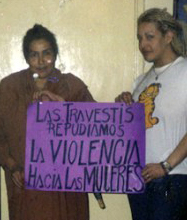
Lohana Berkins and María Belén Correa in a demonstration for travesti civil rights and the repeal of police edicts in Buenos Aires.
6.1 End of Police Edicts
Until the late 1990s, Argentine provinces and the Federal Capital maintained the Edictos Policiales (Police Edicts)—discretionary misdemeanor codes that authorized the police to summarily arrest anyone who "wore clothes contrary to anatomical sex" or engaged in "public scandal".
The mobilization against this daily state of exception culminated in the creation of the Asociación de Travestis de Argentina (ATA) in 1993, led by Claudia Pía Baudracco, later expanded into the Asociación de Travestis, Transexuales y Transgéneros de Argentina (ATTTA). The edicts were formally repealed in the City of Buenos Aires in 1998.
6.2 Leadership and Thought
- Lohana Berkins (1965–2016): Founder of the Asociación de Lucha por la Identidad Travesti y Transexual (ALITT). In 2002, she starred in the historic legal battle to enroll with her travesti name at the Escuela Normal 3 in Buenos Aires. In 2008, she conceived the Nadia Echazú Textile Cooperative, the first self-managed professional training enterprise for travestis.
- Diana Sacayán (1975–2015): Indigenous activist of Diaguita ethnicity and leader of the Movimiento Antidiscriminatorio de Liberación (M.A.L.). She coordinated the pioneering public job quota law and was brutally murdered in 2015, resulting in a landmark criminal trial in the Argentine court that applied the legal classification of travesticide for the first time.
- Marlene Wayar (1968–): Theorist and activist, creator of the newspaper El Teje (published in partnership with the University of Buenos Aires) and author of fundamental works for Latin American sociology on travesti childhood and transgressive pedagogy.
6.3 Pioneering Legislation
1. Gender Identity Law (Ley 26.743/2012): Considered an international standard by the World Health Organization, it secured pure gender self-determination in the civil registry and mandated coverage of gender-affirming procedures by the public health system and private health insurance plans (obras sociales).
2. Employment Quota Law (Ley 27.636 "Diana Sacayán - Lohana Berkins", 2021): Established the mandatory allocation of at least 1% of positions in all branches of the Argentine National State for travesti and trans people.
---
7. Material Reality, Health, and Bodily Technologies
Travesti corporality has been historically constructed through autonomous survival networks, often in tension with biomedical institutions.
7.1 Industrial Liquid Silicone
Faced with denied access to hospitals and the refusal of formal plastic surgery, the use of industrial liquid silicone injections (non-medical grade polydimethylsiloxane) became established in South America. The procedure was performed clandestinely by veteran travestis known as "bombadeiras" (pumpers), who applied the material directly into the subcutaneous plane of the hips, buttocks, thighs, and breasts.
The practice generates severe chronic sequelae: chronic granulomatous inflammation (siliconomas), gravitational migration of the product to the lower limbs, vascular and nerve compression, tissue necrosis, pulmonary embolism, and kidney failure. The surgical extraction of silicone is technically complex and still insufficiently offered in public reconstructive surgery services.
7.2 The Gender-Affirming Process in the SUS
In Brazil, the Ministry of Health established specific care in 2008 (Ordinance GM/MS No. 1,707) and redefined it in 2013 (Ordinance GM/MS No. 2,803), dividing the modalities into primary care, outpatient care (hormone therapy and support), and hospital care (surgical interventions for gender affirmation, facial feminization, and breast augmentation).
Although the protocol guaranteed legitimacy to the treatments, users face severe logistical bottlenecks, such as waiting times of years in queues centralized in a few reference centers and the persistence of bureaucratic requirements that still reflect the historical psychiatric tutelage over the dissident body.
---
8. Structural Violence, Vulnerability, and Mortality
The material precariousness of the travesti population is sustained by a chronic cycle of vulnerabilities that begins in childhood and adolescence:
- Rupture of Bonds and Informality: Coercive family rejection leads to early school dropout due to institutional bullying and transphobia, expelling a large contingent of this population onto the streets and making prostitution one of the only avenues for generating material income and community support.
- The Methodological Critique of the "35-Year Life Expectancy": For years, media outlets and political pamphlets repeated the claim that the "life expectancy of a travesti is 35 years". Contemporary studies in demography and legal sociology clarify that this data is a methodological error: the figure resulted from the arithmetic mean of ages at the time of death within restricted samples of homicides reported by NGOs and media, confusing the average age of murder victims with a formally calculated cohort actuarial life table (such as those from the IBGE). Travesti people can and do live to advanced ages when integrated into protection networks.
- The Reality of Early Mortality: The methodological demystification of the 35-year statistic does not minimize the concrete lethality faced by the group. The relative risk of violent death among travestis remains exponentially higher than the population average. The Transgender Europe (TGEU) network and ANTRA document year after year that Brazil leads the global absolute rates of homicides motivated by transphobia.
- Travesticide: Conceptualized by authors such as Berenice Bento and cemented in jurisprudence through Argentine judicial processes, the crime of travesticide is characterized not only by the death event, but by deliberate cruelty: prolonged torture, genital mutilation, and public exposure of the body, configuring a punitive violence whose symbolic objective is to annihilate the presence of gender dissidence in public space.
---
9. Culture, Traditions, and Language
Despite the adverse context of violence, travestis have constructed cultural matrices fundamental to the South American sociocultural heritage:

Argentine poet, singer, and performer Susy Shock, author of the manifesto "I claim my right to be a monster" ("Reivindico mi derecho a ser un monstruo").
- The Bajubá (or Pajubá): A cryptolalectic vocabulary and dialect structured from the confluence of Brazilian Portuguese and West African languages (notably Yoruba, Fon, and Kimbundu). Originally developed in Candomblé and Umbanda temples, it was adopted and developed by travestis on Brazilian streets to code terms about the police, health, affectivity, and sex work, constituting a mechanism of self-defense and group cohesion.
- Artistic Expression and Resistance: Historical figures have marked the transgressive cultural scene, from Madame Satã in the bohemian Lapa of Rio de Janeiro in the early 20th century and the stardom of Rogéria in theaters and on Brazilian broadcast television, to the contemporary manifestos of Argentine poet and performer Susy Shock and the essayistic and fictional production of writers and researchers like Amara Moira.
---
10. See also
- Gender identity
- Transfeminism
- National Association of Travestis and Transsexuals (ANTRA)
- Pajubá
- Gender-affirming surgery
- Muxe
---
11. Translation and Encyclopedic Fusion Notes
> > [!info] Historiographical Provenance
> The content of this article incorporates, synthesizes, and expands on historiographical and political material originating from two Wikipedia entries:
> 1. Travesti (Portuguese Wikipedia), focusing on Brazilian political chronology, etymology, and the national health reality;
> 2. Travesti (gender identity) (English Wikipedia), focusing on the Argentine legislative trajectory, the overcoming of police edicts, and the conceptual formulation of Travesti Theory.
---
12. References and Cited Literature
1. ANTRA.Dossiê: Assassinatos e violências contra travestis e transexuais brasileiras [Dossier: Murders and violence against Brazilian travestis and transsexuals]. Brasília: Articulação Nacional de Travestis e Transexuais, annual publications (2018–2025).
2. BABY, Jovanna.Memórias da resistência travesti no Brasil: da fundação da ASTRAL à organização nacional. Rio de Janeiro: Editora Metanoia, 2015.
3. BENTO, Berenice.A reinvenção do corpo: sexualidade e gênero na experiência transexual. Rio de Janeiro: Garamond, 2006.
4. BERKINS, Lohana; FERNÁNDEZ, Josefina.La gesta del nombre propio: informe sobre la situação de la comunidade travesti en la Argentina. Buenos Aires: Ediciones Madres de Plaza de Mayo, 2005.
5. BUTLER, Judith.Problemas de gênero: feminismo e subversão da identidade. Rio de Janeiro: Civilização Brasileira, 2003.
6. CARNEIRO, Sueli.A construção do outro como não-ser como fundamento do ser. PhD Thesis in Education. São Paulo: Universidade de São Paulo, 2005.
7. DAVIS, Angela.Mulheres, Raça e Classe. São Paulo: Boitempo, 2016.
8. DAVIS, Angela.A liberdade é uma luta constante. São Paulo: Boitempo, 2018.
9. GONZALEZ, Lélia.Por um feminismo afro-latino-americano. Rio de Janeiro: Zahar, 2020.
10. HARE, L. et al. "Androgen Receptor Gene Expression and Variations in Transgender Identity". The Journal of Clinical Endocrinology & Metabolism, v. 94, n. 1, p. 320–325, 2009.
11. KULICK, Don.Travesti: Sex, Gender, and Culture among Brazilian Transgendered Prostitutes. Chicago: University of Chicago Press, 1998.
12. LOURO, Guacira Lopes.Um corpo estranho: ensaios sobre sexualidade e teoria queer. Belo Horizonte: Autêntica, 2004.
13. MÜLLER, Sven C. et al. "Brain structural and functional connectivity patterns in gender dysphoria: A high-resolution imaging and connectome assessment". NeuroImage, v. 147, p. 112–122, 2017.
14. OLIVEIRA, Megg Rayara Gomes de.O diabo em forma de gente: (r)existências de gays afeminados, travestis e mulheres transexuais negras. PhD Thesis in Education. Curitiba: Universidade Federal do Paraná, 2017.
15. SACAYÁN, Diana.La Ley de Cupo Laboral Travesti Trans: Del desamparo a la reparación histórica. Buenos Aires: Ediciones M.A.L., 2014.
16. SWAAB, Dick F.; ZHOU, Jiang-Ning et al. "A sex difference in the human brain and its relation to transsexuality". Nature, v. 378, p. 68–70, 1995.
17. WAYAR, Marlene.Travesti: una teoría lo suficientemente buena. Buenos Aires: Muchas Nueces, 2018.